
A client writes in English and the reply takes a day because no one on the team feels comfortable answering. A U.S. vendor asks for a call and someone has to be found to take it. If these situations sound familiar, the question isn’t whether English is useful, but whether your operation already needs someone who works in both languages every day. That’s what a bilingual virtual assistant solves.
What a bilingual virtual assistant is and what bilingual really means
A bilingual virtual assistant is a remote professional who works in Spanish and English as part of your daily operation: answering emails, taking calls, coordinating with clients and vendors, and preparing documents in either language.
The key word is “works.” This isn’t English that’s good enough to read an email, but English that holds up in a conversation with a client or a negotiation with a vendor. That’s why how it’s verified matters: writing well and speaking fluently are different skills, and they should be validated separately. We explain how in what vetted talent means.
When your company needs a bilingual virtual assistant
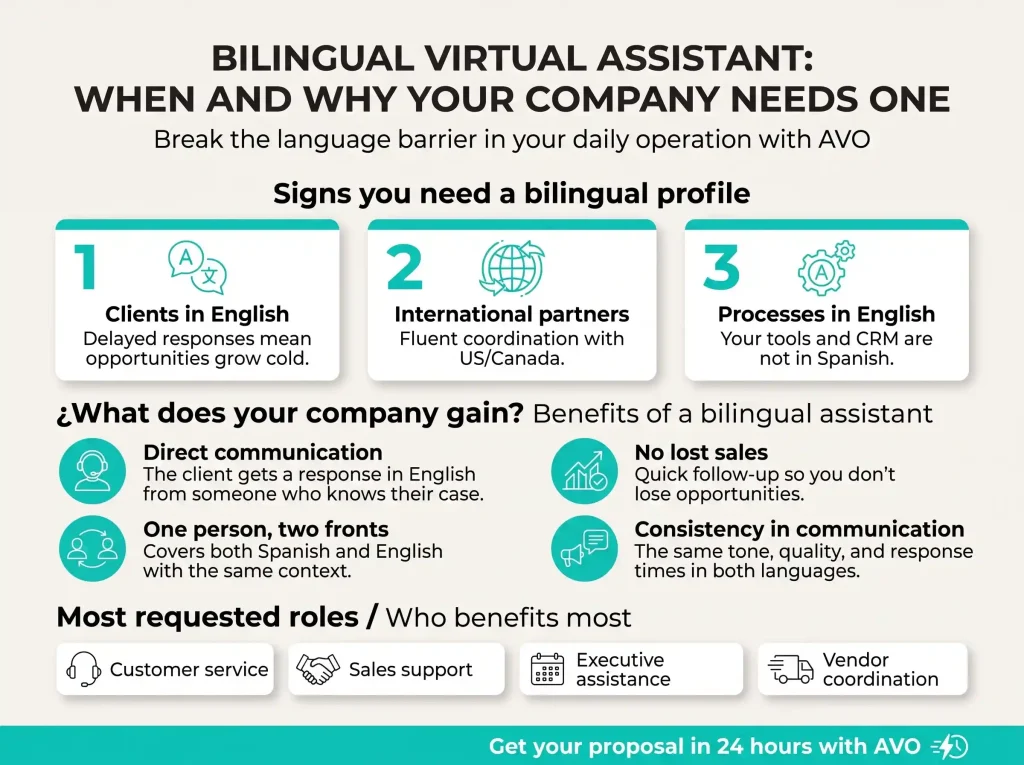
There are fairly clear signs that a bilingual profile is no longer a nice-to-have, but a need:
- You have clients or leads who write in English. Every reply delayed by language is an opportunity that goes cold.
- You work with vendors or partners in the U.S. or Canada. Day-to-day coordination needs someone who doesn’t depend on a translator.
- Your company is in the U.S. and serves Hispanic clients. Bilingual support works both ways: it also lets you serve, in Spanish, the clients who prefer it.
- Your tools, processes or documentation are in English. If the CRM, manuals or reports are in English, the person running them needs to master it.
- You’re entering a new market. Opening operations in another country moves faster if someone can serve that market from day one.
If one or more of these apply, a bilingual profile will likely save you friction from the first week.
When a Spanish-speaking profile is enough
Being honest here also helps you decide well. If your entire operation, your clients and your tools are in Spanish, a bilingual profile won’t add as much as it seems. At AVO, all six service grades are available in Spanish-speaking or bilingual mode, so language is chosen based on what your operation needs, not on the level of the role.
You can also start in Spanish and adjust later: if your functions change and the new scope requires a bilingual profile, the service is reviewed to validate the adjustment.
What your company gains with a bilingual profile
- Service without intermediaries. A client who writes in English gets a reply from the same person who knows their case, without going through someone who translates.
- Sales that aren’t lost to language. A lead who doesn’t get a timely reply often goes with another provider. A bilingual profile follows up in the client’s language.
- One person for two fronts. Instead of splitting service between two people, one covers both languages with the same context.
- Consistent communication. Tone, information and response times stay the same, whatever language the client speaks.
Which roles benefit most from bilingual skills
Not every role gets the same value from a second language. The ones that feel it most are those in direct contact with clients, leads or vendors:
- Customer support: email, chat or phone support in both languages. If you want to build a full team, this guide explains how to set up a remote bilingual customer support team in 30 days.
- Sales support: prospecting, follow-up and booking meetings with clients in different markets.
- Administrative and executive assistance: calendar, email and documents for executives who work with international counterparts.
- Vendor coordination: orders, delivery follow-up and communication with partners abroad.
To see which profiles companies request most and why, check out the most in-demand virtual assistants.
How to choose the right bilingual profile
Before you start looking, define three things:
- Which language each task happens in. Some are mostly written, like email or reports, and others spoken, like calls. That defines which skill matters most.
- What level of experience the role requires. A bilingual administrative profile isn’t the same as a sales or technical one.
- What hours they’ll work. If your clients are in another time zone, the assistant needs to cover those hours.
On cost, a bilingual profile has its own variables worth understanding before you decide. We break them down in what a bilingual virtual assistant in LATAM really costs.
Frequently asked questions about bilingual virtual assistants
Does bilingual mean the assistant is a native English speaker?
Not necessarily. What matters is that their English level, both spoken and written, is enough for the role, and that it’s verified before you meet them.
Can I start with a Spanish-speaking profile and switch to a bilingual one later?
Yes. If your functions change and the new scope requires a bilingual profile, the service is reviewed to validate the adjustment.
Do all service grades have a bilingual option?
Yes. All six AVO service grades are available in Spanish-speaking or bilingual mode.
Need a profile who works in Spanish and English? Get your proposal in 24 hours with AVO.