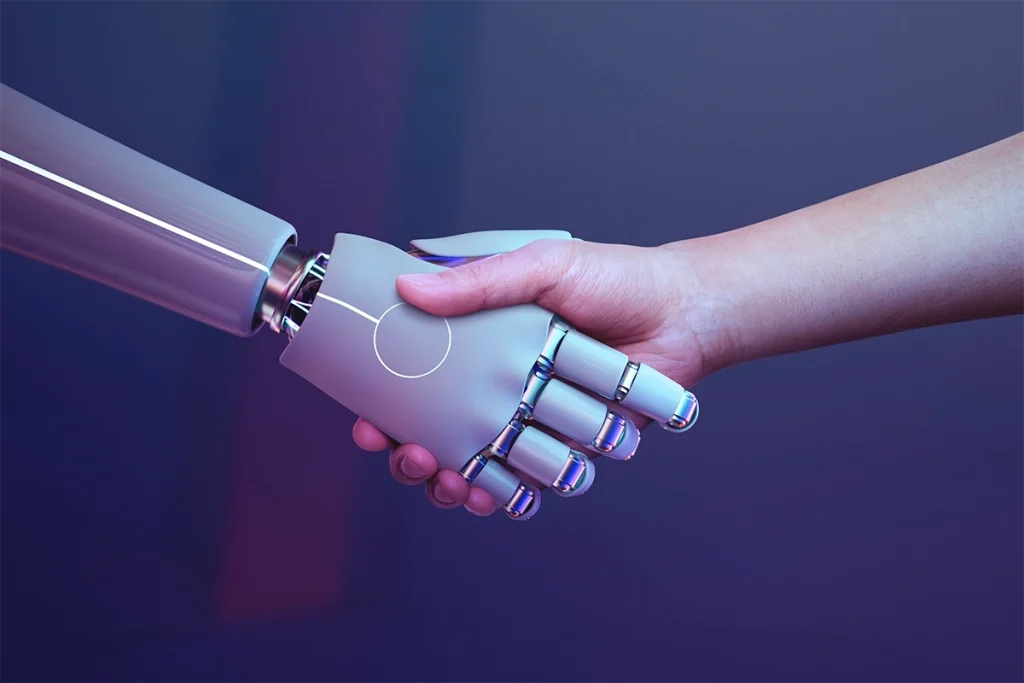
«Should I automate this with AI or hire someone?» is one of the most common questions a business leader asks in 2026, and the answer is almost never one single thing for the whole operation. Before deciding, it helps to understand how to hire a virtual assistant in general, because the decision process is similar whether you’re delegating to a person or automating a task.
What an AI assistant does and what a human assistant does
An AI assistant is software that understands and responds to instructions through natural language processing: it can answer frequent questions, schedule appointments, qualify leads, or send reminders, available around the clock and with no variation from one interaction to the next. Typical examples include a chatbot that handles WhatsApp after hours, a system that confirms appointments automatically, or a flow that sorts support tickets before a human reviews them.
A human assistant, on the other hand, is a real person who can read the context of a conversation, make a call that isn’t written in any manual, and sustain a relationship with a client over time. Examples of this include an assistant who negotiates an exception with a frustrated client, who interprets an ambiguous request without asking unnecessary clarifying questions, or who remembers the full history of a business relationship when picking up a conversation again. These aren’t the same tool solving the same problem; they’re two different tools for two different kinds of work.
Advantages and limits of AI
AI wins on speed and scale: it can handle thousands of conversations at once, respond instantly, and never gets tired of repeating the same question. For repetitive tasks, based on clear rules and high volume (answering frequent questions, confirming appointments, sorting requests), it’s hard to compete with that, and the cost per interaction tends to drop the more it’s used.
The limit shows up when the situation goes off script. AI can recognize when a request doesn’t fit its standard options, but it doesn’t always know how to read the emotional context behind a complaint, or make a call that depends on nuances that weren’t in its training data. It also doesn’t build a relationship the way a person does: it can sound natural, but it doesn’t genuinely remember or adjust to the particular way a specific client prefers to be spoken to, beyond what the system was programmed to do. That’s where the lack of judgment becomes a real problem, not just a technical limitation.
Advantages of a human assistant
A human assistant brings exactly what AI still doesn’t handle well: judgment for ambiguous decisions, the ability to sustain a relationship with a client over time, and adaptation to unstructured situations that can’t be fully anticipated. AVO’s assistants, for example, work under a Spanish-speaking and bilingual model, with ongoing training in professional English and in each client’s specific tools, which lets them adjust tone and judgment to the situation, something an automated flow still can’t fully replicate.
When it comes to deciding who to delegate to and under what model, it’s also worth reviewing the comparison between virtual assistant agency vs. freelance: the same backup and continuity logic that applies there applies to deciding between AI and human, because in both cases the real question is what happens when something doesn’t go as expected.

How to combine them (AI + human) in 2026
The approach gaining ground in 2026 isn’t choosing between AI or human, but designing a hybrid model where each one does what it does best. AI filters and resolves the repetitive work (answering frequent questions, scheduling, sorting requests), and escalates to the human assistant what requires judgment, negotiation, or a sustained relationship. This isn’t just a theoretical idea: it’s already how many support and sales teams operate, where an automated flow does the first filter and a person steps in when the conversation calls for it.
In practice, this can look like a chatbot answering a potential client’s first questions and booking a call, while the human assistant handles that call, the follow-up, and any adjustment that requires negotiating terms. Or a system that sends appointment reminders automatically, while a real person takes the call when a patient needs to reschedule for a reason that doesn’t fit the standard options.
A human assistant powered by AI (using automation tools for supporting tasks, without that replacing their judgment on what actually matters) tends to outperform either option on its own, because it combines the speed of automation with the judgment only a person can bring at the right moment.
What to choose based on your operation
As a quick guide: if the task is repetitive, high-volume, and rule-based, AI is the more efficient starting point. If the task requires judgment, managing a relationship, or adapting to what’s not in the script, a human assistant performs better. And if your operation has a mix of both kinds of work (the most common case), the hybrid model is usually the answer, with an AVO human assistant focused on what adds the most value and automation covering the rest.
This decision doesn’t have to be made all at once or permanently: many companies start by automating a small part and adjust as they see what works. What matters is not automating just because it’s trendy, or delegating to a person tasks a simple flow would solve faster; the question is still task by task, not whole-operation.
You can check out the full detail of AVO’s virtual assistant services by talent grade, to identify what type of human profile makes sense to add to your operation once you decide what part of the work to automate and what part to delegate to a person.
Not sure where to start deciding what to automate and what to delegate? Talk to an advisor on WhatsApp and book your free diagnostic call with AVO.